







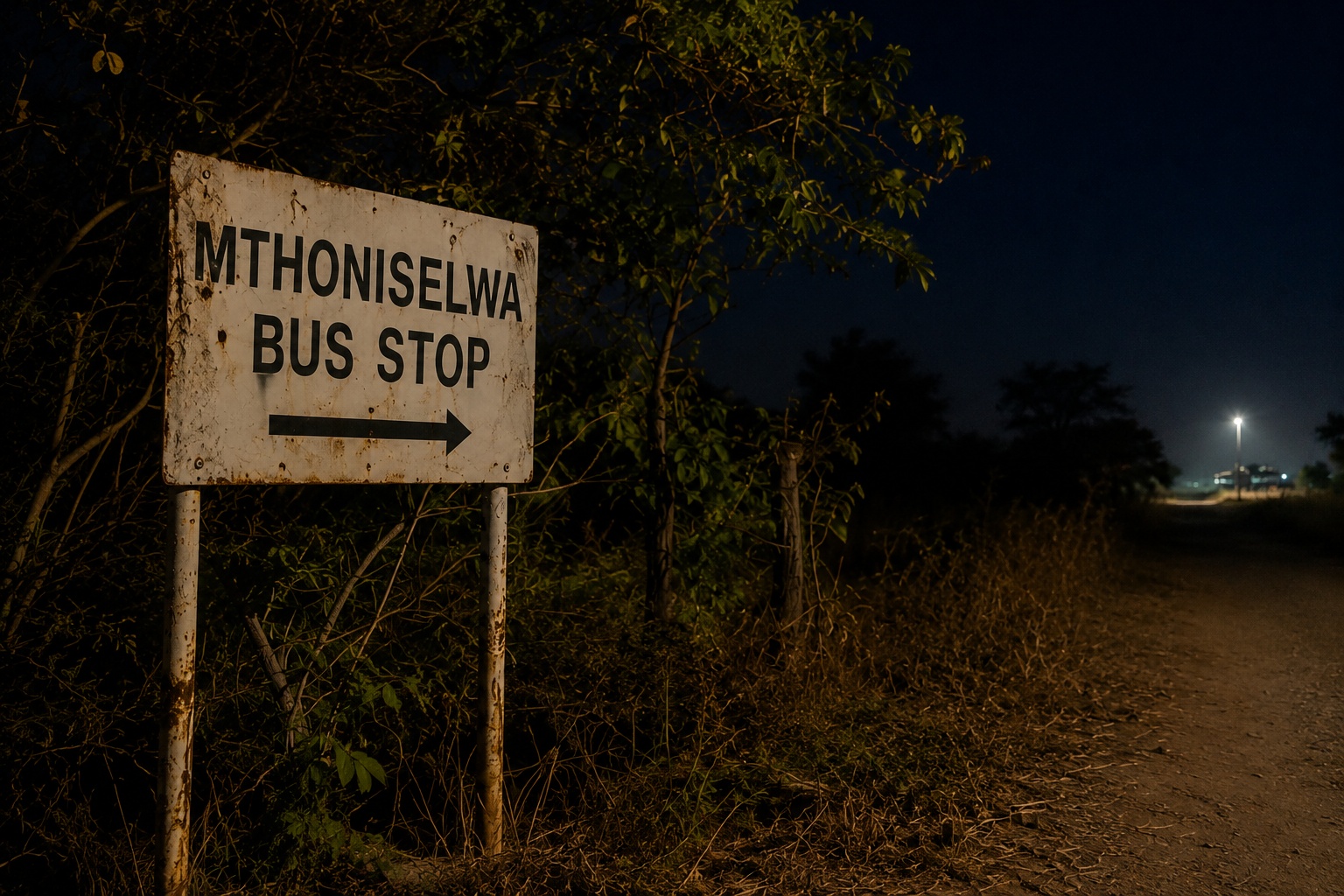
It is past nine on a Sunday night when Mbusi Mabhena steps off the bus at Mthoniselwa village in Nkayi, Matabeleland North. He is walking home.
The Singwangombe River is somewhere in the dark ahead. He knows this path. Everyone in Ward 13, Nkayi, knows it. It is the way home from the bus stop, the way to the fields, the way between one part of a life and another.
He does not arrive.
Mabhena was killed by an elephant near the river crossing on the night of Sunday, 19 April 2026. A man who was walking with him had gone ahead. When he returned, he found Mabhena gravely injured. Villagers rushed to the scene. By the time they reached him, he was dead.
His family buried him the following morning without a post-mortem. No inquest was conducted, no compensation was paid, and there was no early-warning system to warn residents that an elephant was near the crossing.
Zimbabwe Parks and Wildlife Management Authority (ZimParks) confirmed on 21 April 2026 that it had received a report of the incident and deployed personnel to assess the situation. The authority said investigations were ongoing in coordination with the Nkayi Rural District Council (RDC) and the Zimbabwe Republic Police.
In response to written questions from The Citizen Bulletin, ZimParks acknowledged that the systems designed to protect Mabhena did not exist when he died and still do not exist.
The authority did not respond to six questions concerning the investigation timeline and scope, the formal incident reference number, whether the elephant responsible for Mabhena’s death was tracked or killed, patrol frequency in Ward 13, and what community protection measures were implemented following earlier human-wildlife conflict incidents in Nkayi district.
Nkayi RDC, which was also asked to respond to questions relating to interim relief, Communal Areas Management Programme for Indigenous Resources (CAMPFIRE) disbursements and local mitigation measures, did not respond.
Mabhena’s death is not the first linked to the country’s growing human-wildlife conflict. Nor is it the highest-profile one.
On 10 October 2025, Nkulumane legislator Desire Moyo was killed after the vehicle he was driving struck an elephant near Shangani on the Harare-Bulawayo highway. Police said the crash occurred at the 334-kilometre peg at about 2:30 a.m. Moyo, an acclaimed performance poet, was returning from Parliament with four colleagues. He died at the scene.
The crash prompted renewed calls for wildlife warning signs and other safety measures along known wildlife corridors. Months later, there is no public record that permanent warning infrastructure has been installed along the Shangani section of the highway. Nor are there warning signs on the path from the Mthoniselwa bus stop to the Singwangombe River.
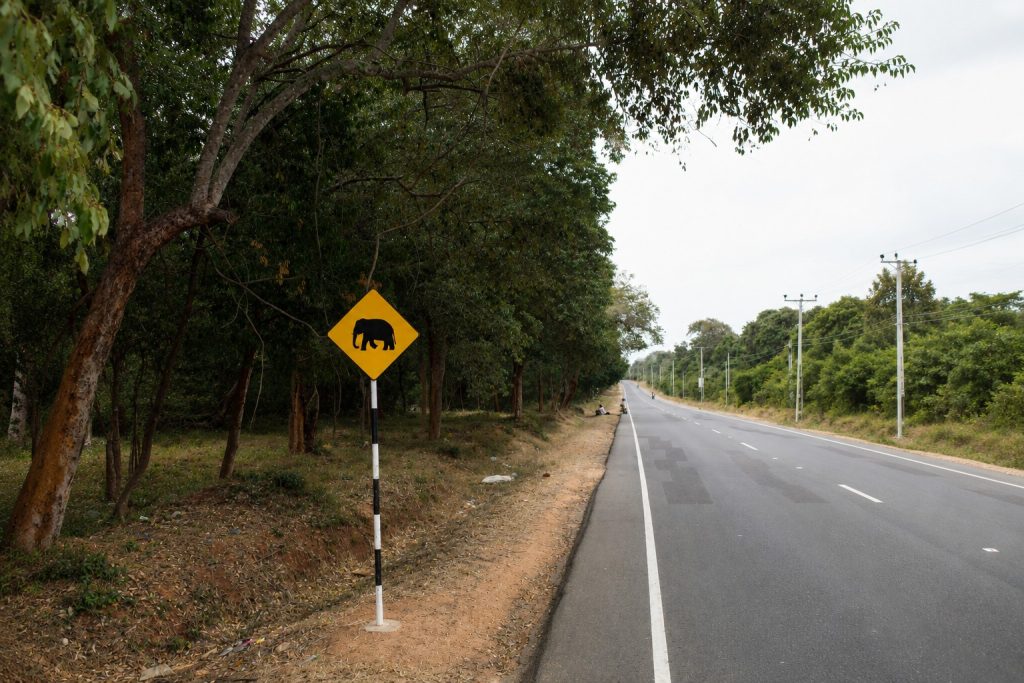
The Singwangombe River crossing in Nkayi’s Ward 13 and the Shangani stretch of the Harare-Bulawayo highway are separated by roughly 200 kilometres.
Both are known wildlife movement corridors. Neither has a permanent ZimParks patrol presence, and both have claimed lives.
Nkayi district borders the Gwayi Conservancy and sits within the broader Hwange-Matetsi-Gwayi corridor, one of the largest elephant migration routes in southern Africa. According to figures in the ZimParks 2023 National Elephant Management Plan, the country’s elephant population has grown to approximately 100,000 against a national carrying capacity of about 45,000.
Research published in 2025 by the Hwange Elephant Research Project documented accelerated range expansion during the 2024-2026 El Niño weather cycle as severe dry conditions pushed wildlife further into communal areas in search of water and pasture.
This is the first time such a catastrophic incident has happened in our area. He was coming from the buses at night when the elephant cornered him at the river.
Weston Msimanga, Ward 13 Councillor
He said the animal’s footprints were identified at the scene the following morning. The elephant was not seen. It was gone before villagers arrived.
A source familiar with the Nkayi RDC’s official records, who spoke to The Citizen Bulletin on condition of anonymity, said at least four human-wildlife conflict incidents had been recorded in the district in 2025 before Mabhena’s death. The RDC neither confirmed nor disputed the figure by the time of publication.
Since Mabhena’s death, fear has changed the way residents move through their own community.
“We are no longer safe, as even lions get to attack some of our livestock,” said one resident who identified himself only as SaMandloe.
The Zimbabwe Christian Alliance (ZCA) also reported in its recent newsletter that lions were terrorising villagers in Gwayi, with some residents losing goats and cattle. The organisation said residents were afraid to walk to nearby villages or fetch water and urged authorities to act quickly before more lives were lost.
Cautious Mthupha, a villager, said the pattern extended beyond elephants. Buffaloes had begun appearing near homesteads.
“We have also started seeing buffaloes coming closer to our homes,” she said. “This is something new and it is worrying.”
The Parks and Wildlife Amendment Act No. 4 of 2025, gazetted in November 2025, formally established the Human Wildlife Conflict Relief Fund. The government first committed to establishing the fund through a Cabinet resolution in November 2022 and a State of the Nation Address by President Emmerson Mnangagwa in August 2023. Three years passed between that commitment and the law.
Five months later, Mabhena was dead.
ZimParks confirmed that the fund has not been established and no claims are being accepted.
No official announcement has been made regarding the opening of the claims application process, prescribed claim forms or administrative procedures for disbursement.
ZimParks said via email
“The prescribed claim forms and submission procedures have not been published. The administrative structure for processing claims is still being developed. On the effective date, which shall be gazetted through a statutory instrument, that is when the fund will begin to accept claims.”
Asked what interim relief is available to families of people killed by wildlife before the fund becomes operational, ZimParks said assistance is provided through the relevant RDC. In some areas, it said, local authorities work with non-governmental organisations and private conservation partners to support victims of human-wildlife conflict.
While ZimParks said interim relief is administered through the relevant RDC, it did not indicate whether any assistance had been provided to Mabhena’s family.
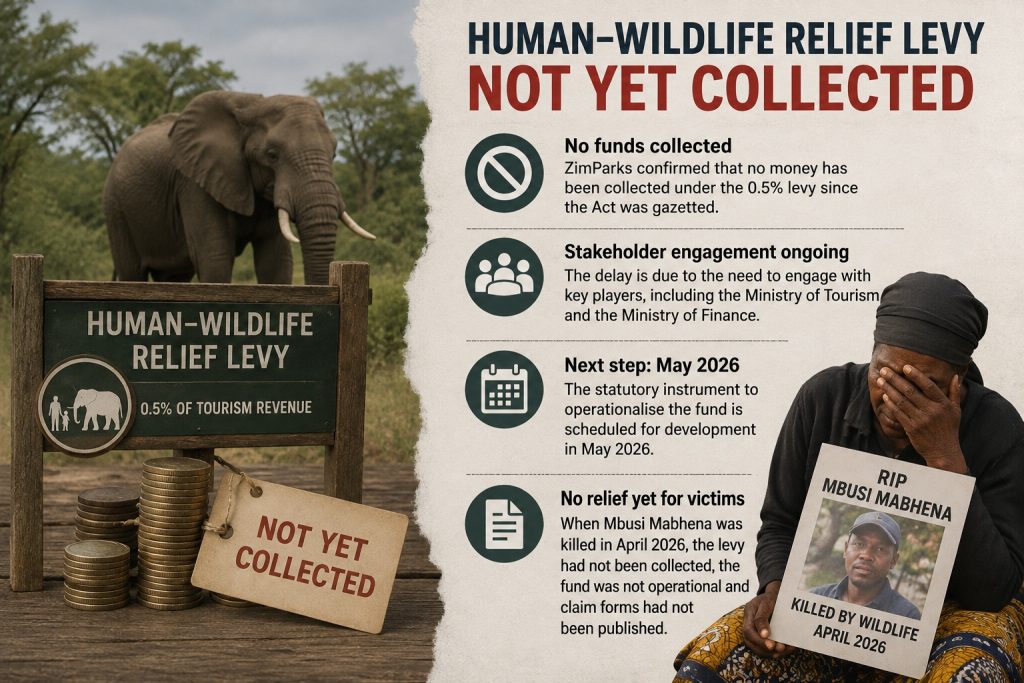
Asked how much had been collected under the 0.5% human-wildlife relief levy on tourism revenue since the Act was gazetted, and when the fund would become operational, ZimParks confirmed that the levy had not been collected.
“This has been necessitated by the need to engage with different players, including the Ministry of Tourism and the Ministry of Finance,” the authority said, adding that the statutory instrument to operationalise the fund was scheduled for development in May 2026.
When Mbusi Mabhena was killed in April 2026, the levy had not been collected, the fund was not yet operational and the prescribed claim forms had not been published.
The Zimbabwe Environmental Law Organization (ZELO) has documented what it describes as systemic accountability failures in the Parks and Wildlife Act. The organisation said information on human-wildlife conflict incidents is “not readily available to the people as provided for under the Constitution” and that attempts to obtain such data are routinely stonewalled by ZimParks. Requests for incident data relating to Nkayi also went unanswered.
Campaigners have also questioned whether the legislation goes far enough. During parliamentary debate on the Parks and Wildlife Amendment Bill in 2025, Mashonaland West Proportional Representative Mutsa Murombedzi described the proposed legislation as “a missed opportunity,” arguing that it established a relief fund rather than a compensation fund for victims of human-wildlife conflict.
ZimParks also clarified that it neither collects nor receives revenue from CAMPFIRE in Nkayi district.
“The Rural District Council has the mandate to manage and distribute benefits from CAMPFIRE to the various wards,” the authority said.
That responsibility rests with the Nkayi RDC. No information was provided on whether Ward 13 has received any CAMPFIRE disbursements.
Academic research published in the Advances in Social Sciences Research Journal in 2021 found that CAMPFIRE generated “mixed feelings” in Nkayi and that communities in the district and neighbouring Lupane viewed its implementation more negatively than communities elsewhere across the country.
The study, which examined the Mbazhe community in Nkayi district, identified a broader conflict between communities and government over whether the programme delivers meaningful benefits or primarily serves state and commercial interests.
The CAMPFIRE Association has reported that wildlife revenues reached communities in Hwange district in 2024. There is no comparable public record of such funds reaching Ward 13 during the same period.
Asked whether any wildlife corridor or buffer zone had been designated along the Gwayi Conservancy boundary under the Parks and Wildlife Amendment Act No. 4 of 2025, ZimParks confirmed that the process “has not commenced yet.”
The authority said the process was scheduled to begin in May 2026 through the development of statutory instruments in consultation with the Attorney General, RDCs and other government departments. The Citizen Bulletin could not independently verify whether that process had begun by the time of publication.
It also clarified that there is no legally recognised area known as the “Nkayi-Gwayi Conservancy.” The relevant boundary is the Gwayi Conservancy, which borders the northern and western parts of Nkayi district.
The law requiring wildlife corridors and buffer zones was gazetted in November 2025. When Mbusi Mabhena was killed five months later, no buffer zone had been designated and the statutory instruments needed to implement the law had not yet been drafted. The corridor where he died remains undesignated, unpatrolled and unmarked.
Despite repeated human-wildlife conflict incidents, warning infrastructure remains absent along the route Mabhena used to walk home. The relief fund announced in 2022 and established in law in 2025 was still not operational when he was killed, and the levy intended to finance it had not been collected.
“Communities are living in fear,” Councillor Msimanga said. “We need urgent intervention to protect people before another tragedy occurs.”
As another night falls over Mthoniselwa village, the Singwangombe River remains where it has always been. So does the footpath Mabhena took home from the bus stop.
Edited by Divine Dube (Guest Editor)