







Summer and winter in Zimbabwe smell different depending on where you stand.
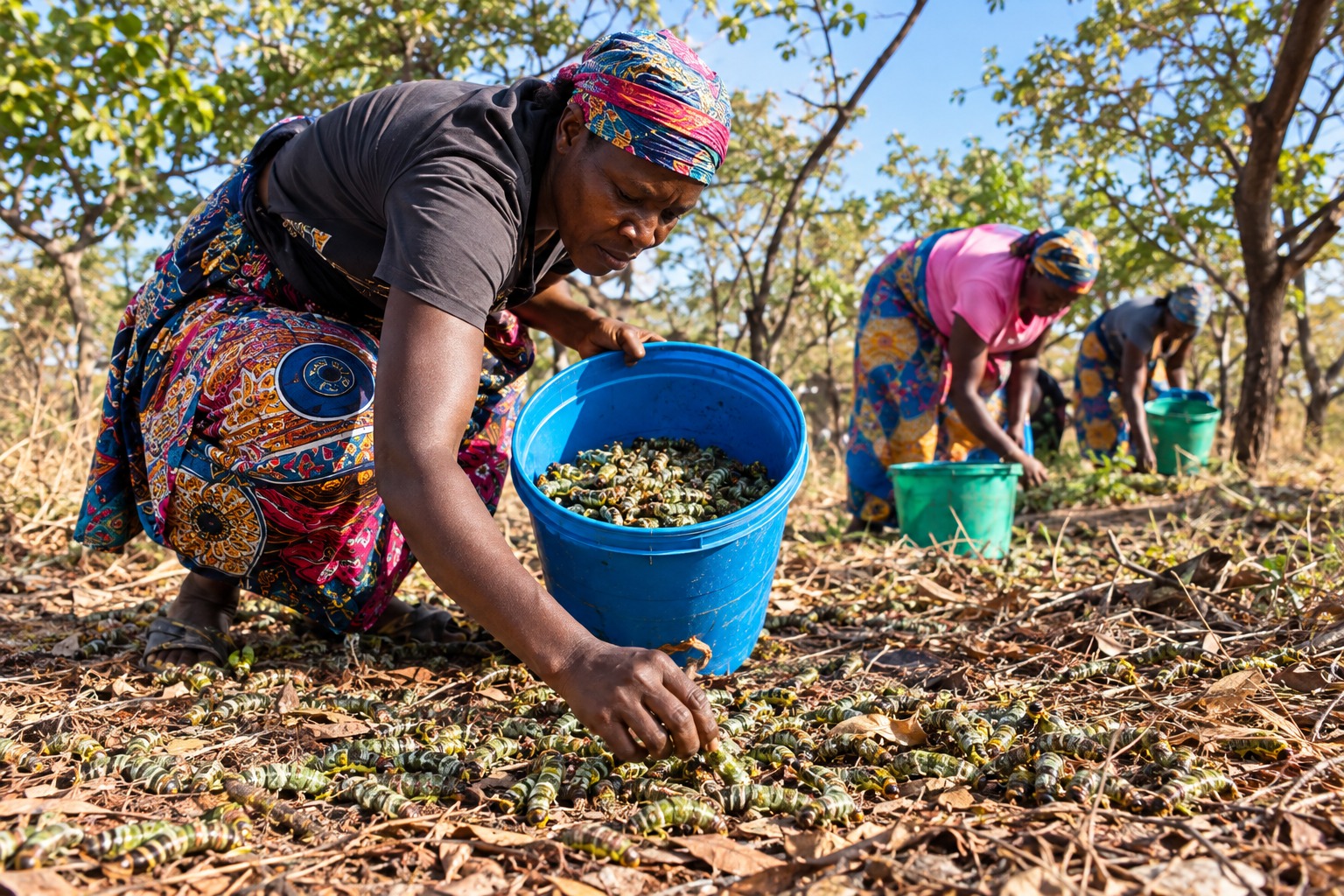
In Gwanda, Matabeleland South, the mopane woodlands are alive before sunrise. Women move in groups between the trees, plastic buckets swinging, eyes scanning the ground. This is macimbi (mopane worms) season.
The caterpillars have dropped overnight and the floor is dark with them. A good morning means a bucket half-full by 9am. A bad one means walking further, because the harvest has been thinner each year. For many households here, 82.9% of them eat macimbi—that bucket isn’t just relish; it’s the school fees. It’s cooking oil. It’s protein when beef has doubled and the rains are late again.
Some 300km north-east, in Mashonaland Central, the sound changes. No mopane. Here it’s hwiza (flying termite) and ishwa (flying ant).
Under msasa and baobab trees, women and children set out before the heat. They are looking for termite mounds and ant nests after the first rains. 80.1% of families in this province harvest ishwa. The insects are smaller, but they come in thousands. Poured into clear plastic bottles, fried crisp in a pan, they pop like rain on a roof. During drought years, when the maize fails, the mounds still give. Researchers call them a “safety net.” The women just call it supper.
And far south, along the Masvingo-Mutare highway in Bikita, the air carries something sharper.
Buses screech to a halt at Nyika Growth Point and women rush forward, dishes balanced on their heads. “Harurwa! Harurwa!,” shouts pierce the empty air.
The edible stinkbugs, (Encosternum delegorguei), have come down with the winter. April to August. No mopane here. These are forest bugs, grilled until their shells crack and stored in clay pots to last the year. A cup is US$1. Forty cups a day can send a child to school. For decades they have been both a delicacy and currency in Masvingo.
Three places. Three insects. One story.
What if edible insects became the new beef of Zimbabwe?
While Zimbabwe has previously seen beef prices double due to macro-economic shifts, current retail prices have not experienced a 100% surge over the past two years.
The rains are becoming even more unpredictable. But in rural Zimbabwe, women are still filling buckets. Not with grain, but with mopane worms, edible stinkbugs, flying termites, ants and grasshoppers falling from the trees or in the grass, mounds and nests. Scientists at Midlands State, University of Pretoria and across Africa say insects like crickets and caterpillars could replace livestock as our main protein—with 12 times less food than cows and 200 times less water to produce the same amount of meat emitting only a fraction of the methane.
As climate change continues to disrupt traditional farming systems across Zimbabwe, communities are increasingly facing crop failures, shrinking grazing lands and rising food insecurity. Yet, an often-overlooked resource is providing a nutritious and climate-resilient alternative: edible insects.
From macimbi in the dry mopane of Matabeleland South, to hwiza and ishwa in the woodlands of Mashonaland Central, to harurwa on the highways of Masvingo, Zimbabwean women are still filling buckets.
Not because it is tradition; it is survival.
As climate change makes fields unpredictable and meat unaffordable, the most resilient protein in the country is the one that crawls, flies and falls from the trees.
The question isn’t if Zimbabweans will eat insects. We already do. The question is if we can farm them fast enough to feed a hotter, hungrier future.
The Agro-Ecological Distribution of Wild Harvested Edible Insects in Rural Zimbabwe study mapped it clearly. Hwiza and ishwa are eaten by 43% of households nationally. Macimbi/madora dominates in Matabeleland North at 75.6% and South at 82.9%. In Mashonaland Central, 80.1% of families harvest hwiza while harurwa is concentrated in Masvingo/Bikita.
But what used to be seasonal tradition is now climate adaptation. Researchers describe non-timber forest products (NTFFPs) like edible insects as “safety nets against adverse effects of climate change.” When drought wipes out maize, insects are still there. They don’t need rain to grow, they don’t need fertilizer and they store for months once dried.
The nutrition backs it up. A 2022 study with authors from National Anglican Theological College and Midlands State University found that Africa’s 1000 edible insect species are high in protein, fats and iron, exactly what’s missing in low-income diets during food shortages. In Zimbabwe, that means termites, ants, crickets and caterpillars are quietly fighting malnutrition while fields lie fallow.
And the climate math is stark. Livestock produces massive CO2 and methane. Insects don’t.
Termites and ants need almost nothing. No land. No water. No feed. Just a mound and rain.
In drought years when maize fails, the mounds still produce. Zero methane. Tiny carbon footprint. Maximum nutrition per kilo.
Harurwa are forest insects. They don’t need irrigation, feed or land clearing. You harvest what the trees produce. Because they are collected in winter, they extend food availability past the rainy season. That’s critical in drought years.
Farming crickets takes very little food and water. University of Pretoria’s Department of Zoology and Entomology is leading insect research in South Africa, with a big focus on making insect farming cheap, scalable and good for food security.
As one paper: Edible insects: future prospects for food and feed security put it, shifting toward insects could help Africa move toward “sustainable food systems” and SDG 2: Zero Hunger.
“Edible insects are now considered a valuable alternative to traditional protein sources because of their high nutritional value, high feed conversion efficiency and lower environmental footprint,” researchers say.
The Food and Agriculture Organisation (FAO) has been one of the strongest international advocates for edible insects as part of sustainable food systems, not as a replacement for conventional foods, but as a complementary source of nutrition, livelihoods and climate-resilient agriculture.
In its landmark 2013 report Edible Insects: Future Prospects for Food and Feed Security, FAO states, “Edible insects contribute positively to the environment, to health and to livelihoods”.
The report argues that insects should be viewed as one of several solutions to global food security rather than a replacement for conventional livestock.
“Contrary to popular belief, insects are not merely ‘famine foods’ eaten in times of food scarcity…many people around the world eat insects out of choice, largely because of the palatability of the insects and their established place in local food cultures,” says the report.
Macimbi are 48-61% protein. That’s higher than beef. They are also packed with iron and fat. For rural households, they land at exactly the right time: November-January and April-June the “hunger months” when granaries are empty and maize hasn’t come in yet.
But they are not just food. They are income.
Dried and packed into 20L buckets, macimbi travel from Gwanda to Bulawayo, Harare, South Africa and Botswana. For many women and youth that bucket is what pays school fees, buys cooking oil and keeps the lights on.
From April to August, the winter air in Bikita smells smoky and nutty. That’s harurwa season.
Harurwa doesn’t need degutting. They are collected in tonnes at “assembly points” in the forest, then fried in large metal pans and dried on mats. In Bikita, they are both relish and cash. A cup sells for US$1. Vendors along the Masvingo-Mutare highway say they can move 40 cups a day. That money buys mealie meal, soap, and school fees.
“I have been surviving through selling harurwa for a long time,” says Mildred Shoko. “I resell to locals and South Africa.”
Another vendor, Marvelous Gondo, trades them for mealie meal and soap. “That’s a huge income for us,” she says.
They are also one of only two insects in Zimbabwe with “significant economic impact”, the other being macimbi.
Notably, for households in southern Natural Region III and IV, they fill the protein gap when fields are bare.
But there’s a problem. The safety net is fraying.
“It used to be easier,” one woman says, wiping sweat. “Now we walk further. The trees are still there, but the worms are fewer.”
The Stewardship of Wild and Farmed Edible Insects in Sub-Saharan Africa report warns “that mopane worm populations are declining in southern Zimbabwe.” Overharvesting, commercialisation, land conversion and climate change are all hitting at once. The trees are still there, but the worms are not emerging like they used to. Weather patterns have shifted. Emergence times are unpredictable.
It’s the same story across the region. The Global Biodiversity Information Facility (GBIF) biodiversity project has only documented 52 edible insect species in Zimbabwe’s Natural History Museum, out of 524 recorded across Africa.
Researchers are blunt: if we keep only wild harvesting, we will lose them. The solution they keep coming back to is farming and semi-domestication. That’s why institutions like the University of Pretoria are testing cheap substrates like maize flour to rear crickets and mealworms year-round.
“Our work focuses on developing cost-effective rearing techniques, harvesting and handling methods, value addition and legislation in order to ensure the sustainable use of insects,” says Prof. Abdullahi Ahmed Yusuf, University of Pretoria.
One key quote from the research is that NTFFPs like edible insects provide “safety nets against adverse effects of climate change” that cause agricultural insecurity.
Simply put, when drought kills your maize, the forest still gives you food and income. That’s why NTFFPs are such a big deal for food security in rural Zimbabwe.
Zimbabwean researchers argue that edible insects can only make a lasting contribution to food security if they are supported by conservation, production and policy. In a 2022 study, they said the country’s data on edible insects “offers an opportunity to advocate for the conservation, production, processing and promotion of specific species… and can be used as an advocacy tool for policymakers.”
Other researchers have warned that government legislative frameworks “scantly give reference to sustainable utilisation of edible insects as a main priority,” even as studies point to declining populations of widely consumed mopane worms.
That’s why studies are now pushing for something new: insect farming or “semi-domestication.” Instead of only picking wild caterpillars, researchers want communities to rear them in controlled mopane plots.
“While these serve as safety nets against adverse effects of climate change, populations are declining from overharvesting, shifting rains, deforestation, and export pressure. The solution now lies in moving from wild picking to insect farming. Controlled mopane plots for year-round supply, stable income, and less pressure on forests,” proffers Daniel Sithole of environmental lobby group, Green Shango.
From the mopane dust of Gwanda, to the termite mounds of Mashonaland Central, to the highway in Bikita – women are doing what they’ve always done. Harvesting what the land gives when the rains don’t.
Different insects. Different regions. Same story
Climate change is making crops fail. These insects are making sure people don’t. The next step isn’t just eating them. It’s farming them, protecting their habitats, and putting them in policy.
For now, women like Mai Ndlovu still walk the mopane each morning. One bucket can mean school fees. Two can mean food until the next rain season. But everyone knows the harvest is getting thinner.
“The insects that carried us through past droughts may not be enough for the next one, unless we learn to farm them.”